Pages

Wednesday, July 12, 2017

A Kite Flies, and Art is Beautiful, Because of Rules

Some time ago I watched a video that appeared on my Facebook feed. Since I fancy myself some form writer, and work with a lot of artists, the video piqued my interest, and I actually turned on the sound to listen (which I rarely do, since most of the videos on Facebook are junk).

The video didn't draw my attention because I thought it was interesting, or educational, or funny, but because the first ten seconds were incredibly stupid and patronizing, and I wanted to see how far this rabbit hole of stupidity went. I have included a link to the video below, on Youtube.

https://www.youtube.com/watch?v=bgnFl7vidGk

For those of you who have more respect for your time than I do, allow me to quote some choice lines from the artist who is both the subject of the video and also the narrator.

"Since I was a little boy, I was curious about art. I didn't understand it, because I couldn't find its rules. But for arts, there are no rules like there are for math and grammar. It's a field without conventions, and that's what makes it so exciting for me."

What?

How does that make any sense?

To be fair the video continues on and the artist spouts off some typical motivational dribble about following your dreams, and being different, and so on. But who's idea was it to start the video with this nonsense? Clearly it wasn't an artist, or the artist in the video, and if it was he clearly doesn't know what he's talking about. And I feel most other designers, artists, writers, or whatever, would agree with me because...

Art is beautiful because there are rules.

A final art piece is revealed at the end of the video and it looks amazing, why? Does he use lines of perspective with a vanishing point? Yes. Does he use contrasting colors? Yes. Is everything to scale? Yes. Are there highlights to accentuate the important focus of the piece and draw your eye to the center? Yes. is there a horizon to simulate the height of the view? Yes. Does he use a lighter application of the medium (sand) to simulate clouds and a heavier application to simulate solid structures? Yes. Etc. etc. etc.

Obviously his art is overflowing the with the correct use of a lot of the rules of art with which we are familiar. By saying he's breaking new ground, and working in a field unhindered by rules, is stupid, and insulting to everyone else who actually understands what they are doing.

I don't want to limit this analysis to just painting and traditional art. The artist in the video even mentions that there are rules in grammar and math, and isn't this what makes the correct application of these rules so beautiful and engaging?

Why are artists and graphic designers, and web developers paid so much for what they do? Why do we grow up wishing to be a famous artist, actor, or musician? Because they know how to use these rules to create something beautiful, they know which rules work well together and, more importantly, when to break them.

An artist knows that yellow and blue make green. That seems like a solid rule.

A writer knows that active verbs command greater attention than passive verbs. That's a rule.

An actor knows that facial expressions are more important than the scripted words. Seems like a rule.

An architect knows that tapering a column towards the top make a more appealing sculpture. That's an ancient rule.

A photographer or a graphic designer knows that the human eye perceives beauty in the golden mean. That's definitely a rule:


Though I'm not a fan, I recognize this is why "modern" art became so popular so fast: because it takes a skilled artist to recognize which rule to break and when. You can't just do whatever you want, you'll end up with chaos, a mess. And you can't just decide that one rule isn't important for no reason, that makes it ugly. But by breaking the right one, some amazing modern art, sculpture, and paintings have been made, and draw huge crowds at museums to this day.

Why was Shakespeare so famous as a playwright? Because he understood the rules of grammar and writing and meter so well that when we chose to break rules he knew exactly the effect it would have on the audience.

Rules are good, rules help us make sense of what is happening. I remember when I really learned the true importance of rules in math when I saw a Mandelbrot Set.

As quoted directly from Wikipedia:
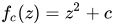
"The Mandelbrot set is the set of complex numbers c for which the function  does not diverge when iterated from z=0, i.e., for which the sequence  remains bounded in absolute value."

My, that sounds like a lot of complicated rules. But what happens when we see these rules of the Mandelbrot set rendered on a graph, in color? Behold:

But wait, it gets even better, by continuing to apply the rules, further and further (rendered in videos as a "zooming in") we get images like this:


and these, known as "Julia Islands":


and this, known as a "seahorse tail":


And the list goes on. In fact, there are so many applications of this specific set of rules that entire classes revolve around them, and mathematicians are dedicated to its study and development. How sad it must be for these people to have to deal with these pesky rules.

I think about it this way: the reason a kite can fly in the wind isn't due to the strength of the wind, the size of the kite, the design, the location, or anything like that, it's because it is tied to a string. I've seen hundreds of different kite designs, some with tails, some without. I've seen kites fly in no wind, and some in storms. But every single one had to have someone with a string at the other end or it would crash.

It almost seems count-intuitive. But it's a rule. As much as a kid might cry and yell that he wants it to go higher by cutting the string, the only result will be a kite stuck in a tree or falling to the earth. By tethering the kite to the ground, or your hand, you allow it to fly, and be beautiful. We need rules to create art. Art is the correct application of rules, and trying to get around them, or ignoring them, is like trying to fly a kite without a string.


Wednesday, June 14, 2017

The Two Brothers


Once upon a time
there were two brothers
one was rich, he had many things
and ate and drank well
all his days
The other was poor, he had no gold
he worked hard and had no time
for luxury

The rich brother spent his days
in the company of strange women,
his nights with mischievous men.
He scorned his neighbors,
and ignored his lessors.
He abused his friendships
and honored not his word.

Then one day the rich man indulged too much
and he died

Many people came to his funeral
many words were spoken
but no tears were shed
After, his friends left quickly
and never looked back

Only the brother remained
left behind to ponder his loss
And then to ponder his gain
For he had inherited his dead brother's wealth

The dead brother, meanwhile,
awoke in the Void
Surrounded by a darkness so thick
he thought it would crush him
into nothing


He heard nothing
and everything
at the same time.
The void was silent
He was alone

For miles and miles,
for eons and years,
he was alone.
Yet he heard a sound,
a constant humming,
coming from within
or all around
The whimpering,
wailing,
and crying of tormented souls,
his soul,
or all souls
he did not know

Not the wailing of those in pain
but the weeping of those now realizing
the permanence of their isolation
their loss

In time,
or in no time at all
his feet touched on solid ground
His mind awoke
his senses roused
his panic began

He cried to the gods for deliverance
He knew not their names
never had he cared
He cried and he pleaded
But the sound disappeared
and no one heard
and nobody one came

The he thought of his brother
He who now had his wealth
He who would surely fall
victim to the same vices as his elder

He must be spared
He must be saved
He must be warned

Louder again he raised his voice
Harder again he struggled against the black
to save his brother
he prayed for intervention

Then the darkness parted
his eyes could finally see
the shadows moved away
and a figure took shape

A man,
long blonde hair flowing form his head
unimpeded by the dark
moved effortlessly
slowly
towards him

A robe draped his arms and shoulders
The hilt of a sword rose behind his ear
the leather holster fastened across his chest
A darker belt sat firm around his waist

"I have heard your cries."
he said in a whisper
"I am here to answer,
what do you desire?"

The brother
eager for a ray of hope
forwent his curiosity
and begged

"My brother is surely in peril,
for I shewed him no love
in the land of the living
and left him my vices.
He will surly fall
he will soon fail.
Please send me back to warn him
of the fruits of my life."

"As you wish it to be, so let it be done."
Was the reply with a smile and a wink
and the stranger turned away

The darkness enveloped the man
he passed out of consciousness
he could see nothing
only shadows
then shadows of shadows
then shadows of things
shapes
outlines
colors:
his home


People passed by
unaware of the new visitor
they laughed, they drank
vices were indulged
curiosities satisfied
hungers sated
days passed in the blink of an eye

His brother was found
away in a room,
face-down in the covers
compromised and shameful

"Brother" he called
a woman to the side stirred
"Brother" again, no motion

He reached to awaken him
his hand passing through the flesh
like etherial wisps, his fingers felt no touch
In a panic he called, "Brother, why do you not hear me!"

The naked man started
he turned in a panic
his eyes passed around the room, searching
confusion wrote itself on his face
he saw no man

"See, brother." The rich man implored. "Here am I."
The other squinted his eyes to a line
Following the voice to its source
"Methinks I have been made to partake of too much drink.
For I do behold mine elder brother before me!"

His chance for redemption was here
there was no time to waste
"Younger brother, take heed of my words
for I come with a warning of despair and grief.
Where I find myself now, you will surely be bound,
an eternity of suffering and endless torment is your only reward!"

His brother looked back
no words left his lips.
"Younger brother, I implore, abandon these ways."
His hand waved the room
"These will not come with you, they will not be your joy.
My fate is sealed, but your life can be saved.
Forsake these vices
give unto the poor
treat the downtrodden as your own.
Or misery awaits you."

Silence followed his voice like a fox
His younger brother thought, and then
a laugh

A loud laugh
a mocking laugh

"Ho here! My elder brother returned from the dead
to haunt my steps!"
His mockery echoed in and out of the etherial plane
"Behold how he comes in my hour of joy to mar our rejoicing!"
He bellowed to a crowd of furniture

"Even in death he cannot leave me be
to enjoy his passing."
An evil laugh escaped his lips.
"Oh brother, my brother,
in life you cared not for me.
You kept your riches,
your concubines,
your pleasures,
to yourself.
You did not know your younger brother.
Nor cared for him in need."

"Indeed, your passing is the greatest of favors!"
He pointed.
"Look upon my riches,
my wealth.
How I revel in your gifts!"
A finger pierced his ghostly breast.
"How jealousy must brew within your heart!
That you cannot rest in peace.
But return to plague me with tales of the Void!"

"Nay, brother, do not speak.
But listen.
I will not cease in my merrymaking.
You did not share with me in life,
I will not depart from it now in your death.
Feign not concern for me,
he who begged at your table in vain!"

"Begone, now, phantom.
If indeed your gifts are rewarded with chains,
then in chains I will tell you of their purchase!
Begone, and vex me no more."

Darkness again surrounded the man
he passed out of consciousness
he could see nothing
only shadows
then shadows of shadows
only darkness
only silence
nothing

His cries for succor went unheeded
His brother did not return
his world was gone
his brother
him home

Then laughter
again
a cold laugh
a biting laugh


The blonde man appeared before him
a wicked smile bared his teeth

The man cried
"Oh lord of the Void,
Why have you brought me back?
My deed was not finished.
My brother not saved
Why return me to this place?"

"Thou fool!"
A thunderous reply
"Your brother was lost
the moment he entered your world.
Forsaken by his brother,
now given the life he envied.
Not a thousand specter visitations
would alter his path."

Another laugh had no echo
"But now
he has been warned of his fate
no doubt remains in his head.
The Void awaits,
mouth gaping wide.
And to continue in your ways
against such knowledge,
yea, his fate will be far worse than yours.

"Indeed, thanks to you,
his elder brother,
he will envy your position in eternity
and curse your name forever."

"You who delayed your compassion
and prolonged your revelry.
And left the time of your concern
until the hour was the latest.
And doomed your brother
to the darkest of pits."

The blonde man faded
the twilight disappeared
no sensation followed
no light
no sound
no warmth
only the Void.


Tuesday, April 25, 2017

What makes a good writer?

"Many books require no thought from those who read them. And for a very simple reason: they required no such effort from those who wrote them"
-Charles Caleb Colton


Where I have the wonderful opportunity to work, I hear and see a lot of conversation regarding "good writing".

I'm also positive that we have all had the experience of clicking and reading an article we see online only to make it a couple paragraphs and either:

1. Have no idea what we just read, or what the article was trying to say.

2. Have such a difficult time wanting to continue to the end that we don't finish reading at all, or simply skip to last paragraph to see if there is anything important we missed.

As we all know, there are three sides to every story: your side, my side, and the truth. And I can't remember a time when this has been more true than today. With such polarizing political, ethical, and moral parties vying for attention, all three versions of any story are resembling each other less and less. So reading both sides of what happened during a particular event is even more important, which is what got me thinking about "good writing" in the first place. All "sides" of any argument today are guilty of both "good" and bad writing. I've read articles and stories and opinions posted online from both sides of the aisle that really grab me and almost force me to read to the end. Not because I necessary care about the issue, or agree with the author's point of view, but because the flow and feel of the piece really makes me want to continue.

On the other hand I have also read my fair share of articles that compel me to zone out, or leave, and sometimes persuade me side with their opposition. Is it because their positions, facts, data, or ideas are wrong? No. (Well... sometimes, but that's a different argument) But rather its the way the writing makes me feel as I read.

I want to be clear. I understand that most of what we read (and see, and hear, and even say) today is blatantly skewed to illicit a specific response from the target audience. **Insert Marketing 101 reference here**  And I think that most of us are intelligent enough to recognize this device when we see it. What I mean is the reaction I have to the actual writing, the words, the flow, the connection with the writer.

Anybody can write "Today an orphanage burned down in upstate New York, the firefighters were too busy putting out the fire that the couldn't rescue a dog and her five puppies from drowning in a river outside of town." And make you feel sad. In fact, how often do we do that with news sites? (the search engine Bing does this a lot) We look just at the headline: "Orphanage burned, puppies drown" and feel sad, then move on.

But what will actually get you to read the rest of the article (if there is one, and not just the usual paragraph-and-a-half synopsis of the sad afternoon)? What will make you actually care about what is being said? What will inspire you to action? It's good writing that will do that.

We have graduated from self-help books to self-help Youtube tutorials, or quick-fix Quora articles written by someone who tries to hawk their get-rich-quick book at us. Yahoo Answers is a minefield of questionable advice. Is this bad? Not at all, but we do have to be careful (especially if we're getting cooking tips from Youtube comments!), but nowhere have I seen this behavior more prevalent than online writing.

One reason this is true, I believe, is because online writing is so accessible. You can't just decide one afternoon to bake a three-layer cake, or create a survivalist herbal garden in your living room. But finding a how-to guides on how to write effectively and throwing up a "how to solve world hunger" article takes all of five minutes. I don't know about you, but it is obvious to me when someone has just left the "how to write good and how to do other things good too" school.

It all comes down to our voice and not our skill. Which is something online writers miss when they think they've 'made it' as a writer, or a political blogger. It doesn't have to do with grammar or the size of the author's vocabulary, necessarily. What most "bad" writers I've seen online all have in common is that they've all abandoned their own voice and instead are trying to imitate the self-help guide they found. Good writers pour their heart into their work, and as a result we can connect with them. Bad writers fret over the best word choice, sentence composition, the balance of compound and simple sentences, even how the article "looks" online. Do all these things help? Of course, but I've noticed they are more often used to compensate for the fact the author has no voice of their own. They' have become one of the many, a clone of the guru.

I could be an expert in a certain topic, yet I will enjoy reading an article in a journal, magazine, or newspaper about that topic because the author has made the familiar, unfamiliar. By exploring a familiar topic from a new angle, with a new voice, with new colors, they make the article engaging and exciting. 'Bad' writers make the unfamiliar familiar by finding interesting topics, hard questions, or hot-button issues, instead of writing that about which they are passionate, and so they lose their voice.

I'm more than sure we have all heard the common complaints from those who fancy themselves "learned" or an "expert on literature" from time to time. For me, the most often complaints came when Harry Potter was introduced.

"JK Rowling is a terrible author. Have you even read her books?"

"She writes at a 4th-grade reading level!"

"So much of her work is copied form other authors, or blatantly plagiarized from myth, she's so unoriginal!"

(The same complaints can be attributed to so many other authors, directors, poets, etc. But I pick this one because I feel more people can relate)

And yet she's successful, she's a millionaire. They made movies of her books, and so on. People buy multiple copies of the same book because they love it so much. Why?

Surely it can't be because of her extensive vocabulary? Is it because of her experience in simile, exposition, prose, or sentence structure? It must be because of all the subtext, the intricately woven sub-plots?

I don't think so. (Correct me if I'm wrong)

It's because she has a voice. She put her dreams on paper and leads us by the hand into a world so lovingly created that we can't help but care for it, and wish we were a part of it. She made the familiar (witchcraft) unfamiliar in so many different ways.

This ties back to the quote at the top of this post: I think we check out of so many articles online because we can tell, intuitively, that they are almost copy-pasted from somewhere else, it doesn't engage our mind, and more importantly, our heart. On the other hand, others will draw us in and refuse to let us go because the author toiled and fretted over how to make the piece theirs.

Don't feel bad when someone criticized the books you like to read, or the articles you find entertaining or engaging. They are good for a reason, and that reason is not something you can quantify or measure. You relate to it, you invest in it. Don't judge the quality of an article, or a book, based on the skill of the author's writing, a few quotes I've found that help highlight this point:

"A multitude of words is no proof of a prudent mind."
-Thales

"The most valuable of all talents is that of never using two words where one will do."
-Thomas Jefferson

"A designer knows he has achieved perfection, not when there is nothing left to add, but when there is nothing left to take away"
-Antoine de Saint-Exupery

If you're reading an article that takes three paragraphs, and 4-syllable words to describe something simple, you've found an egotistical writer who just found a new how-to guide. On the other hand, if you find yourself five pages in when you only wanted to read the title an move on, you've found a good writer. One that says what they think, and not what they think others want to hear. They draw you into their world, and don't try to force themselves into yours.